
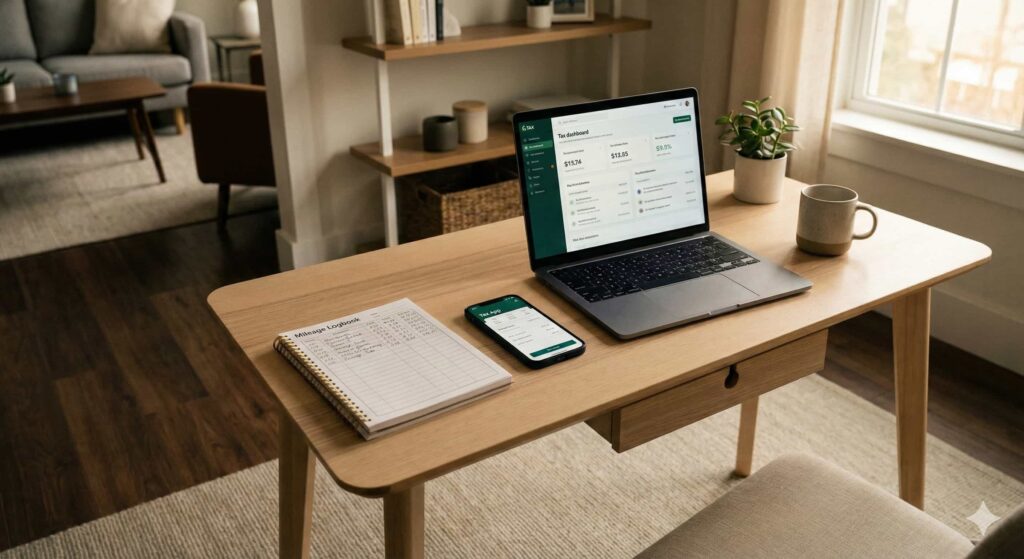
As a rideshare driver, your car is obviously your primary workplace. However, you also spend hours outside the car managing your business—tracking mileage, responding to support tickets, and balancing your books. This leads to a common question in 2026: Can Uber or Lyft drivers claim a home office deduction?
The answer is yes, but only if you follow the strict “Exclusive Use” rules set by the IRS. For many drivers, missing out on this deduction means leaving hundreds of dollars on the table. And claiming it incorrectly can increase scrutiny if not substantiate properly according to IRS guidelines.
Does Your Living Room Count?
The IRS is strict about the “Home Office Deduction.” To claim it, your space must be used regularly and exclusively for business. As a driver, your car is your primary workplace, but your home can be your administrative office.
What Qualifies?
- A dedicated desk used ONLY for bookkeeping, mileage logs, and scheduling.
- Storage space used exclusively for business supplies (cleaning kits, water for passengers, etc.).
Pro Tip: Most drivers use the “Simplified Method,” which allows a deduction of $5 per square foot (up to 300 sq ft, max $1,500).
Don’t forget that mileage is still your biggest deduction. Make sure you are using the best deduction method before adding home office expenses.
The “Principal Place of Business” Test
This is why many drivers ask: “Can I really have an office if I’m driving all day?” According to IRS Publication 587, your home office can qualify as your “principal place of business” if you use it for administrative or management activities and have no other fixed location where you conduct these tasks.
For instance, since Uber doesn’t provide you with a desk or an office to do your paperwork, your home desk becomes that dedicated space. Consequently, you can claim a portion of your home expenses even though you do the “actual work” (driving) on the road.
The Strict “Exclusive Use” Rule
Importantly, the IRS does not allow “mixed-use” spaces. If your business desk is also where your kids do their homework or where you pay your personal bills, the deduction is disqualified.
Therefore, you must have a separately identifiable space used only for your rideshare business to avoid unnecessary scrutiny. Photographic documentation of the space can help substantiate exclusive use if ever questioned during an IRS review.
Simplified vs. Regular Method: Which is Better?
Generally, drivers have two choices when calculating the deduction for the 2026 tax year:
- The Simplified Method: As mentioned in our Pro Tip, you claim $5 per square foot (up to 300 sq. ft). It requires less record-keeping and is often the safest bet for gig workers.
- The Regular Method: You calculate the actual percentage of your home used for business and apply that to your rent, mortgage interest, utilities, and insurance. However, this requires keeping every single receipt and bill.
Ultimately, you should use our 2026 Uber & DoorDash Tax Estimator to see how different deduction methods impact your real dollars.
Why Drivers Still Prioritize Mileage
While the home office deduction is a nice bonus, remember that your vehicle expenses (the Standard Mileage Rate, set by IRS Notice 2026-10 at $0.725 per mile) will almost always be your largest tax shield.
In fact, many drivers find that focusing on the 2026 IRS Mileage Deduction Calculator yields much higher savings than home office costs. Ultimately, the home office deduction should be the “icing on the cake” of your tax strategy, not the main focus.
🛡️ Important Disclaimer & Fact-Check
This guide is based on 2026 IRS tax rules and IRS Publication 587 (Business Use of Your Home). Because tax laws regarding the “administrative office” for gig workers can be complex, this is not official legal advice. Tax laws and thresholds may change, and this content is updated annually for accuracy. Finally, we strongly recommend consulting a CPA to ensure your home office meets the “Exclusive Use” criteria to avoid any IRS red flags. Data Source: IRS.gov.